

Hearing Involves More Than Sound Volume
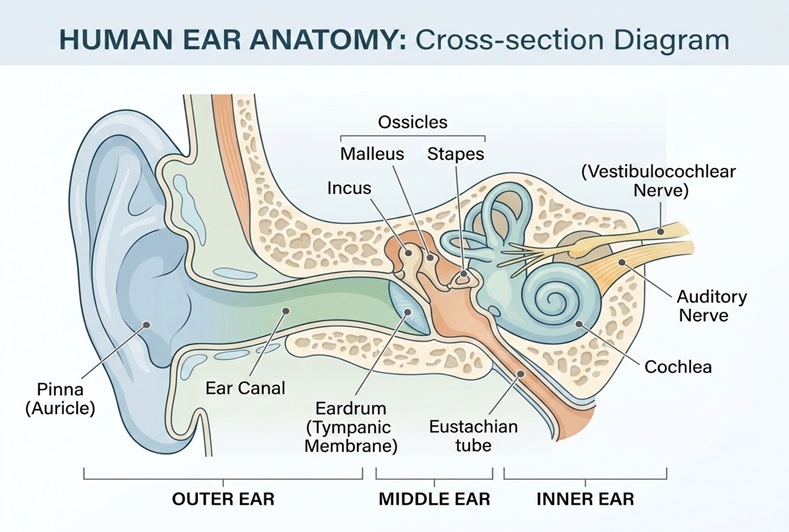
Hearing isn’t simply about whether you can hear a sound. It depends on several parts of the ear and brain working together, including the outer ear, ear canal, middle ear, inner ear, auditory nerve, and brain.
Each part has a role. The ear collects sound, passes along vibrations, converts those vibrations into electrical signals, and sends them to the brain, where they’re interpreted as meaningful sound. Because of this, ear structure and hearing health are connected, but they’re not the same thing. Someone can have concerns about the shape or appearance of the outer ear and still hear normally. Another person can have significant hearing loss even when the visible ear looks completely typical.
Understanding the relationship between ear anatomy, hearing evaluations, medical care, and hearing technology can make it easier to choose the right kind of care.
How the Ear Works as a Connected System
The ear has three main regions: the outer, middle, and inner ear. The outer ear includes the visible ear, also called the pinna or auricle, and the ear canal. Sound travels through the canal until it reaches the eardrum. The eardrum vibrates, and those vibrations move through the small bones of the middle ear before reaching the cochlea in the inner ear.
Inside the cochlea, specialized sensory cells help turn those mechanical vibrations into signals the brain can interpret. Since the visible ear is only one part of this process, changing its appearance doesn’t automatically affect hearing. Procedures involving the external ear may focus instead on position, symmetry, size, shape, or structural differences.
North Texas Facial Plastic Surgery, for example, describes otoplasty procedure as an individualized procedure designed to reshape, resize, or reposition prominent or misshapen ears. The practice also provides facial plastic and reconstructive surgery.
This distinction between structure and function is important. Someone seeking care for an external ear concern may still need a separate hearing evaluation if they’re experiencing muffled sound, ringing, pressure, or a noticeable difference between ears.
Why External Ear Structure Still Matters
The outer ear isn’t where sound is converted into nerve signals, but its shape still plays a role in hearing. The curves of the pinna help collect sound and guide it toward the ear canal. From there, sound must move through the middle and inner ear before the brain can make sense of it.
Ear anatomy can also affect comfort and fit when someone wears a device in or around the ear. Shape, canal size, skin sensitivity, and other physical factors may influence how well someone tolerates hearing aids, custom hearing protection, in-ear monitors, glasses, and similar equipment. That matters because even a technically effective device won’t help much if it’s uncomfortable enough that someone avoids wearing it.
Good hearing care isn’t only about amplification. Comfort, fit, and everyday usability matter too.
Hearing Evaluations Show What Appearance Can’t
You can’t always identify a hearing problem by looking at the ear. A professional hearing evaluation can show how well someone detects sounds across different frequencies and how those results may relate to real-world listening difficulties.
Testing can also help identify broad types of hearing loss. Conductive hearing loss involves difficulty transmitting sound through the outer or middle ear. Sensorineural hearing loss usually involves the inner ear or auditory pathway. Mixed hearing loss includes features of both.
These differences matter because different causes may call for different forms of treatment or hearing support. Apex Audiology provides comprehensive hearing assessments along with hearing aid services. The practice states that its evaluations include interpretation of test results and recommendations based on those findings. It also notes that anatomical and medical factors can influence hearing aid style.
Rather than choosing a hearing device based only on appearance or features, a hearing evaluation can provide a more useful starting point.
Different Ear Problems Can Cause Different Types of Hearing Loss
Hearing loss isn’t one single condition. A blockage in the ear canal may affect hearing differently from damage to the sensory cells in the inner ear. Problems with middle ear movement can also interfere with the way sound travels.
Otosclerosis is one example. It involves abnormal bone remodeling in the middle ear, which can interfere with normal sound transmission. Sensorineural hearing loss is commonly associated with factors such as aging, noise exposure, disease, certain medications, or other conditions affecting the inner ear.
Hearing aids are often used to improve access to sound and speech for people with sensorineural hearing loss, although the right option depends on the person’s hearing profile and overall condition.
Where the problem is occurring can be more useful than simply knowing that hearing has declined. Two people may both describe their hearing as “muffled” while having completely different underlying causes. That’s why evaluation should come before assumptions about treatment.
When Ear Symptoms Need Medical Attention
Some hearing changes happen gradually. Others appear alongside symptoms such as pain, pressure, drainage, congestion, dizziness, or a blocked sensation. These symptoms don’t always come from the inner ear. Earwax, infections, inflammation, respiratory illnesses, trauma, and other medical conditions can affect the ear and nearby structures.
A medical evaluation can help determine whether the issue needs treatment before longer-term hearing care is considered. Carolina Urgent Care, for example, lists eye, ear, and throat concerns among the conditions evaluated through its urgent care services in North Carolina. Urgent care may be appropriate for some short-term symptoms, while persistent, recurring, or complex problems may require follow-up with an audiologist, otolaryngologist, or another specialist.
Sudden hearing loss deserves particular attention. A rapid change in hearing, especially in one ear, shouldn’t automatically be blamed on congestion or earwax. Sudden sensorineural hearing loss is a medical condition for which prompt evaluation can be important.
Hearing Aid Success Depends on Fit, Not Just Features
Modern hearing aids offer sophisticated sound processing, but technology alone doesn’t determine whether someone will use them successfully. The right device depends on both hearing needs and physical factors.
An audiogram can show which frequencies need support, while a hearing professional may also consider dexterity, lifestyle, ear anatomy, skin sensitivity, comfort, communication goals, and the listening environments that cause the most difficulty. Those factors can help determine whether an in-the-ear, behind-the-ear, receiver-in-canal, or another hearing aid style is a practical choice.
Follow-up matters too. A hearing aid that feels uncomfortable, sounds unnatural, or struggles in certain environments may need adjustment rather than replacement. Hearing care often includes an adaptation period in which programming, physical fit, listening strategies, and expectations are refined over time.
Long-Term Hearing Health Requires Ongoing Care
Hearing can decline gradually enough that the person experiencing it doesn’t notice the change right away. Family members may be the first to notice higher television volume, repeated requests for clarification, or trouble following conversations.
Age is one common contributor to hearing loss, but long-term noise exposure can also have cumulative effects. Ongoing hearing care may include regular hearing evaluations, protection from excessive noise, appropriate earwax management, hearing device maintenance, and reassessment when listening needs change. Infinity Hearing, which has a location in Sanford, Maine, provides hearing evaluations, hearing aids, hearing aid fitting and support, earwax management, custom hearing protection, tinnitus care, and other hearing services.
This kind of ongoing care matters because hearing health isn’t always addressed with one test or one device. Hearing can change, technology may need adjustment, and communication needs can shift with work, health, family life, and daily routines.
Better Hearing Supports Everyday Communication
Hearing loss often becomes most noticeable during conversation rather than during a formal hearing test. Someone may hear that another person is speaking but struggle to make out individual words, especially in restaurants, group settings, or other noisy environments.
Over time, those difficulties can affect everyday behavior. A person may participate less in conversations, avoid social gatherings, misunderstand instructions, or feel tired from concentrating so hard to follow speech.
Hearing loss has also been associated with social isolation and reduced quality of life. Hearing technology and other communication strategies may help some people stay more involved in daily activities. Support doesn’t have to stop with amplification.
Simple strategies can help, such as facing the person who’s speaking, improving lighting so facial cues are easier to see, reducing background noise, using captions or assistive listening technology, and asking others to speak clearly instead of simply speaking louder. Combined with appropriate hearing care, these adjustments can make everyday communication easier and less tiring.
Looking at the Whole Ear and the Whole Person
Hearing health involves anatomy, sensory function, medical care, technology, and everyday communication. The visible ear is only the beginning of a much larger system that allows the brain to recognize and understand sound. Because problems can develop at different points along that pathway, appearance alone can’t tell you how well someone hears.
A more complete approach considers both ear structure and hearing function. Regular hearing evaluations, attention to new symptoms, proper hearing protection, carefully fitted technology when needed, and ongoing follow-up can all support long-term hearing health.
The goal isn’t simply louder sound. It’s easier communication, better access to everyday conversations, and greater comfort in the situations that matter most.